

The Department of English, in collaboration with the Contemporary Poetics Forum, International Islamic University, Islamabad, organised a book launch for Prof. Dr. Ayaz Afsar’s newly published book, Qur’ānic and Biblical Narrative Discourse: A Contemporary Approach, on the 20th of March, 2019. Prof. Dr. Ayaz Afsar is the current dean of the Faculty of Languages and Literature. His book, published by the Islamic Research Institute at the International Islamic University, Islamabad, comes after numerous articles which he had previously published on the topic. It is an interdisciplinary study that makes use of literary and linguistic methods to compare and analyse the narrative elements of the Biblical and Qur’ānic texts.

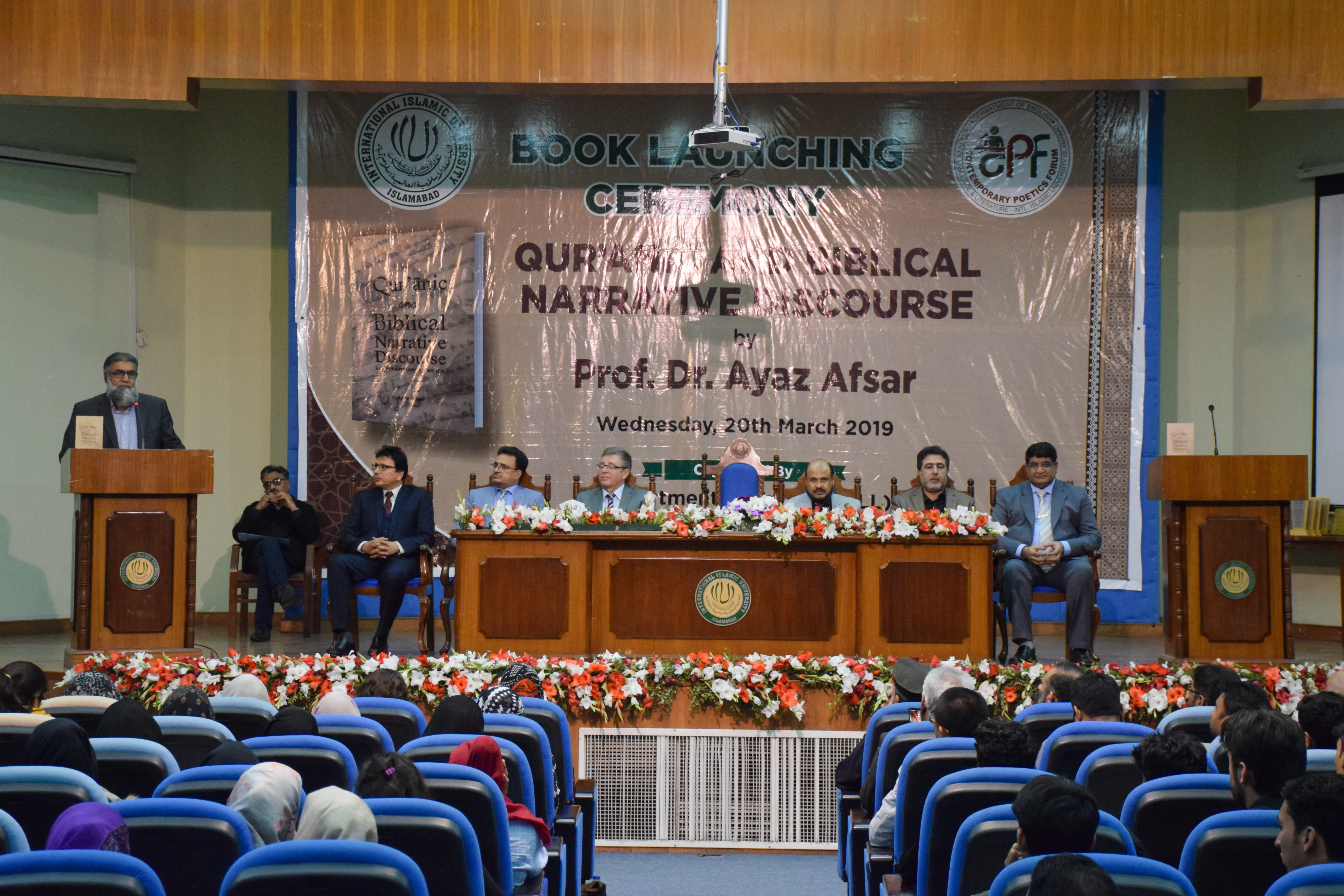
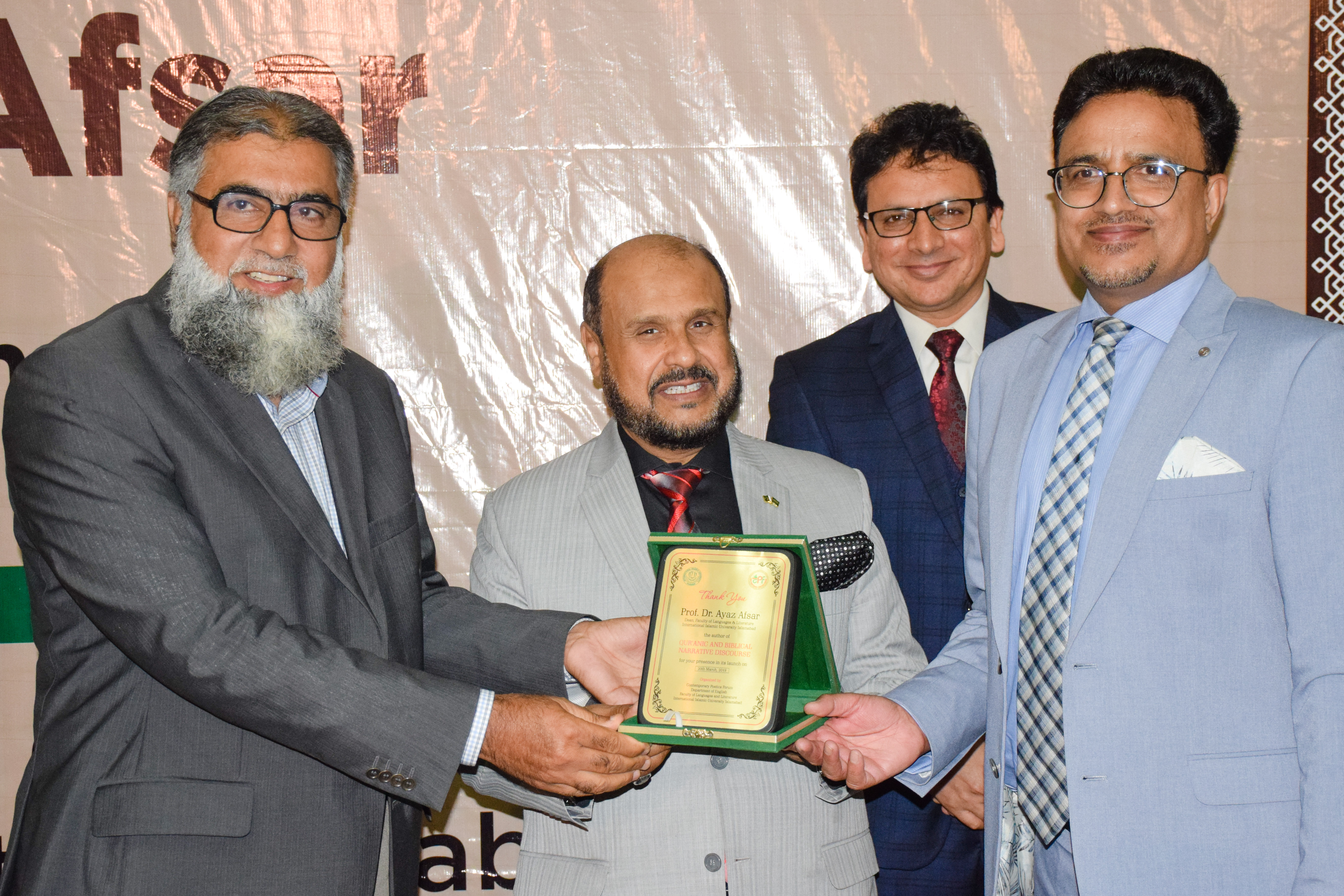


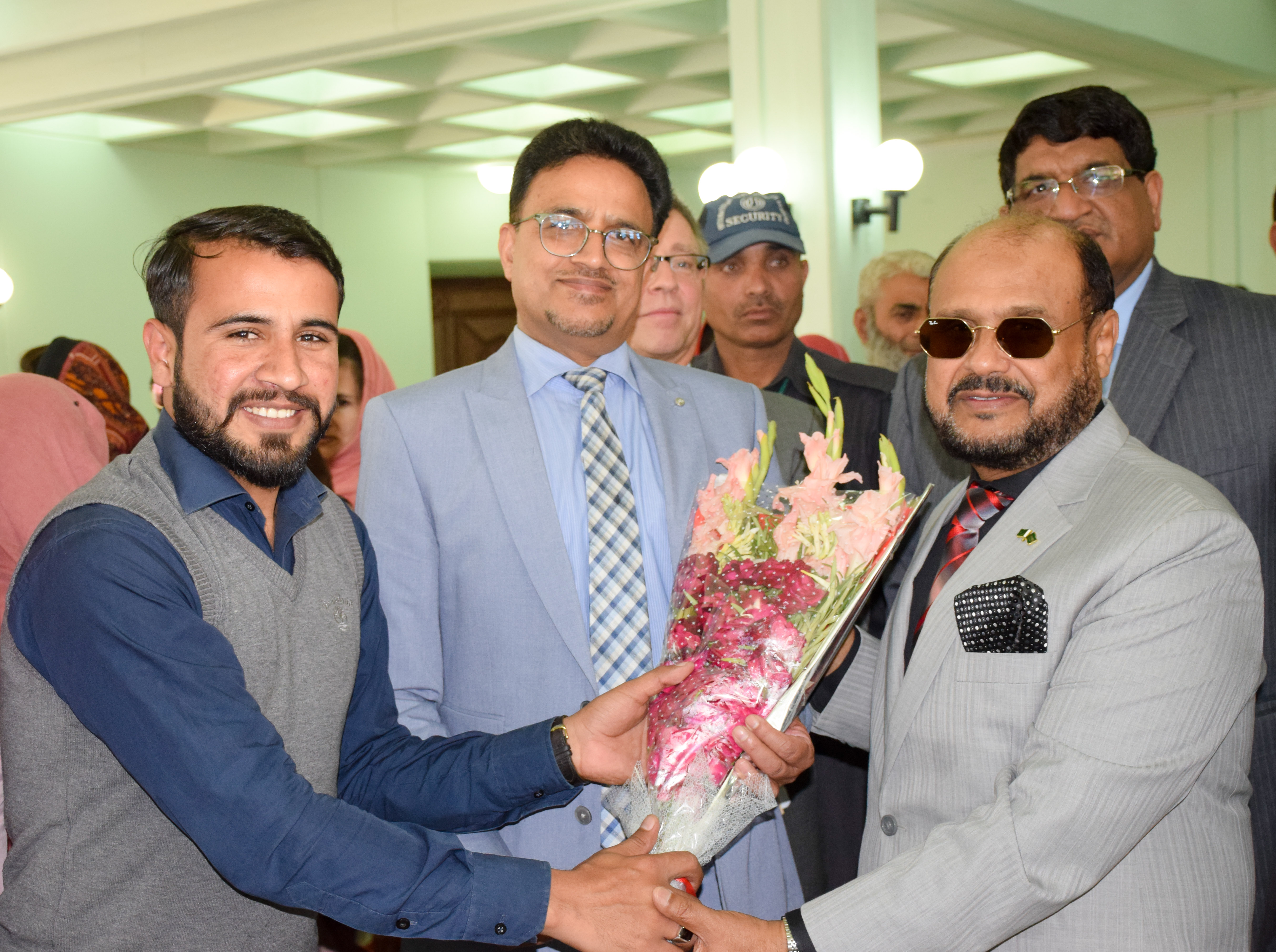
The session was hosted by Dr. Akhtar Aziz, who moderated the session and also gave it some context by quoting from both the Qur’ān as well as the Bible. The session was opened by a recitation of the Holy Qur’ān, which was then followed by a welcome note by Dr. Muhammad Sheeraz, the chairman of the Department, who congratulated Dr. Ayaz and also discussed the importance of his work in context of the need for harmony in contemporary society. Mr. Farrukh Nadeem then proceeded to share his short review of the book, mentioning how it applies the literary methods of narratological study to the comparative study of religious texts. What the book does, he said, was to study the narrative structure and the aesthetic scheme of these texts, focusing on the how rather than on the what.
After Mr. Farrukh’s analysis, Dr Amal Sayyid was invited to share her thoughts. She discussed the text in context of recent racial and religious conflicts and mentioned how it shows an alternative response that focuses on shared narratives rather than on difference. She also foregrounded the fact that Dr. Ayaz’s work does not try to liberalise Islam or to produce some sort of apologetic, but rather it acknowledges the narratives shared between faiths without sacrificing anything to the secular. She also mentioned how it goes beyond both post-modern approaches that begin with scepticism as well as those that fail to look at these texts as anything more than a rulebook.
Dr. Husn ul Amin, the executive director of the Iqbal Institute for Research and Dialogue, discussed the book in context of the recent discussions in Qur’ānic studies, particularly those that have to do with the Qur’ān’s structure and style. He stated that Dr. Ayaz’s book is relevant to the students of Islamic Studies, Social Sciences, Literature, and Linguistics. Dr. Zia ul Haqq, the head of the Islamic Research Institute, added to this by discussing the university’s academic work, especially with regards to the Islamic Sciences and in shaping a society.
Prof. Dr. Sebastian Gunther, a Germany based Islamic Studies scholar, was also present at the session and he stressed how Dr. Ayaz’s work focuses on the potential for understanding each other rather than on differences. He also appreciated Dr. Ayaz’s focus on the aesthetic and narrative structures of these texts.
Dr. Ahmad Yusuf al-Draweish, the president of the university, stressed the need for research and invited everyone to participate, and Dr. Yaseen, the rector of the university, laid stress on the fact that the purpose of universities is to produce research.
Copies of the book were also available for purchase and many students had them signed by Dr. Ayaz Afsar, who stayed there for as long as he could to facilitate those who wished to talk to him about his work.
 Contemporary Poetics Forum